Where Video Lives Now: A Practical Map of Film Audiences
Last updated: September 11, 2026
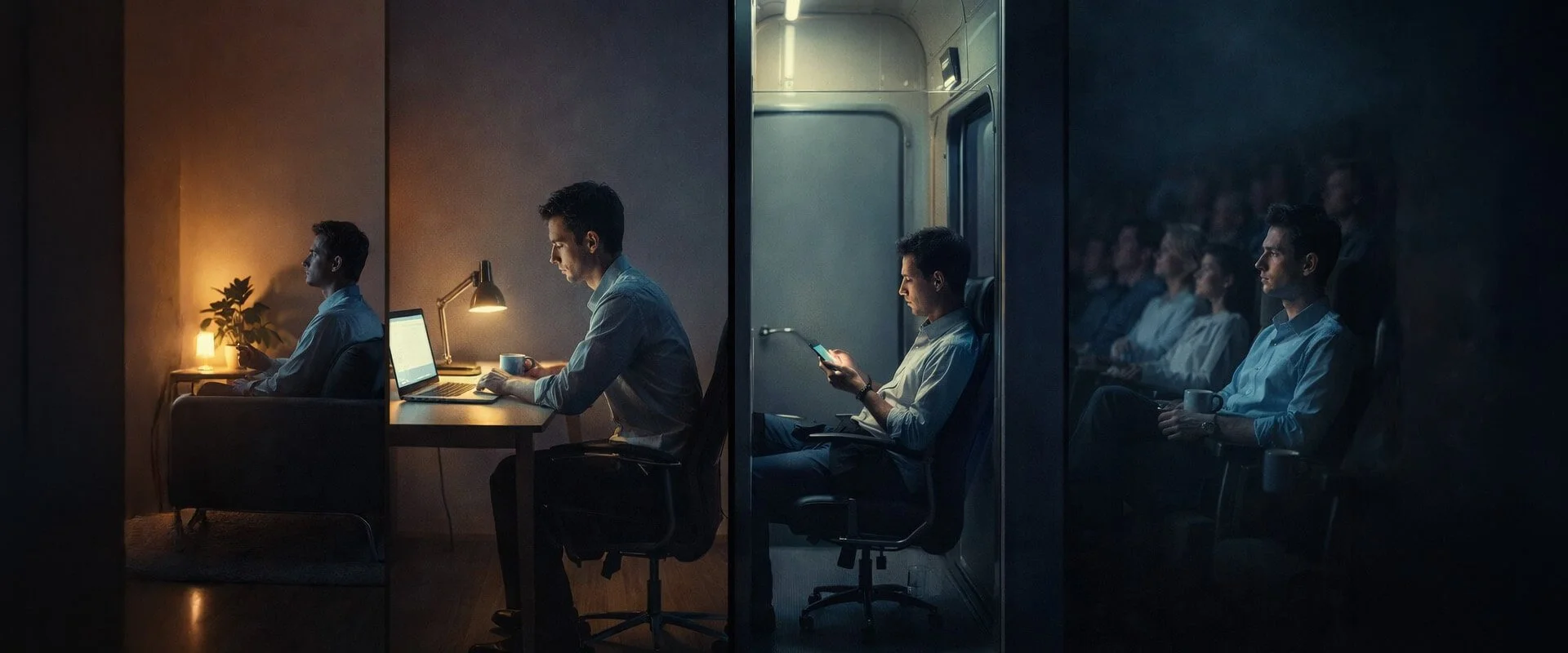
Last Friday night, you watched two films back to back. The first was in a cinema, a room full of strangers sharing the same hush, no glowing phones, no pauses, just a slow build that felt electric. Later, you played a short from the same director on your phone, one earbud in, half relaxed, half reachable. Notifications popped up. You paused to reply. You rewound a moment you missed. Halfway through, it started to feel like homework, not because the film suddenly got worse, but because the contract changed. Same story, different room, different rules.
I have watched that contract change on my own work more times than I would like. In fifteen years of commissions for organisations including Cambridge University Press, VSO and Royal Holloway, the piece that failed was almost never badly made. It was made for a room the audience was not in. A film cut for a conference screen got watched on a phone on the Northern line. A social edit built around sound played muted in a feed. Viewers do not feel demographics first. They feel whether the work is keeping its promise, which is what the research on audience expectations and viewer interaction keeps finding.
The short version. Plan for how someone is watching, not which platform they are on. Four modes cover almost everything, lean back, lean forward, on the go and communal, and each one forgives different faults and punishes different ones. Mode predicts what a viewer will put up with far better than the platform label does.
This post is the map I use for that, with tools you can screenshot, tables you can reuse, and a set of decisions that travel across cinema, TV and mobile without turning into platform arguments. It applies whether the footage comes from a crew or from a model. Those decisions sit inside a wider set of notes on audiences and attention.
On this page
Seven decisions that come up on every job. Jump to the one you are stuck on.
Start with how they are watching, not where
The useful starting point is the deal you are asking the viewer to accept. What do they have to give, time, focus, emotional effort, patience? What do they get back, escape, insight, catharsis, a laugh, a feeling of belonging? The deal changes with posture, company and interruption level, and it changes again when the cost of leaving drops to zero. When the deal is clear, people forgive rough edges because they know what they are here for. When it is fuzzy, even beautiful work can feel like effort because the viewer keeps asking what the point is.
A good habit is to treat cinema, TV and phone as three rooms with different rules. Cinema is high-commitment attention with stronger social norms. Home viewing is lower-friction attention where pausing is normal. Phone viewing is often high-interruption attention where leaving costs almost nothing. If you want a clean mental model for how these rooms create different behaviours, the clearest reference point on this site is how people switch between cinema and streaming.
Cinema programming thinking helps here because it begins with motivations and habits rather than abstract categories. It treats audiences as people with patterns, and it pushes you to describe what they want and how you communicate it, which is captured well in cinema audience motivations and habits.
Shared watching also has a real mechanism behind it. Research suggests that shared emotional experiences can increase social connection, which helps explain why a room full of strangers can feel linked by the credits, in shared emotion builds social bonds. Studies on shared experience also suggest that synchronised reactions can strengthen bonding, which is one reason the cinema hush can feel different even when you would never speak to the person next to you.
The viewing contract canvas
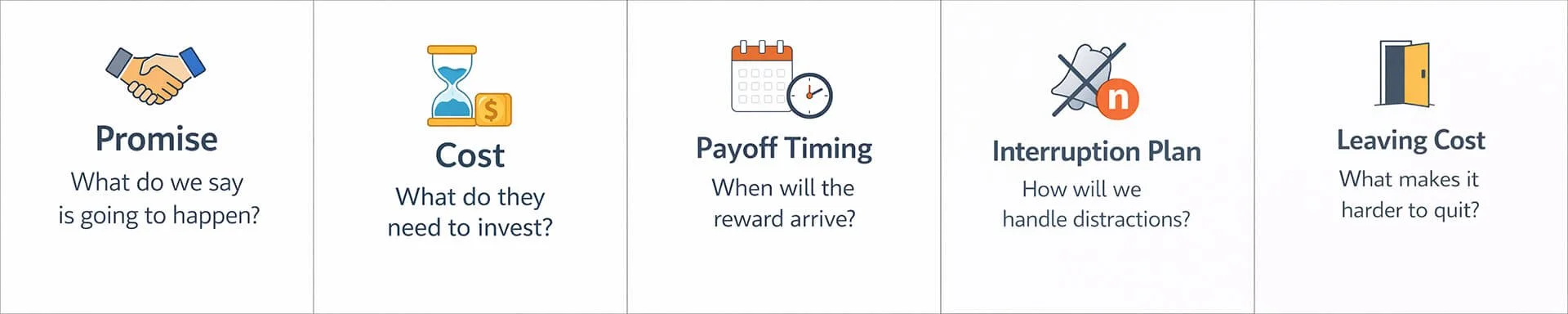
This is designed to be screenshot friendly and used repeatedly. Answer these before you write, shoot or cut anything, and be honest with yourself about the cost.
1. The promise. What is the viewer meant to get, in plain language, and why should they care?
2. The cost. What are you asking the viewer to give, time, focus, emotional effort, patience?
3. The payoff timing. When do they get their first real reward, and how often do you pay them back?
4. The interruption plan. If they miss 15 seconds or pause twice, can they still follow the thread?
5. The leaving cost. How easy is it to abandon, and what makes staying feel worth it?
The viewer mode matrix
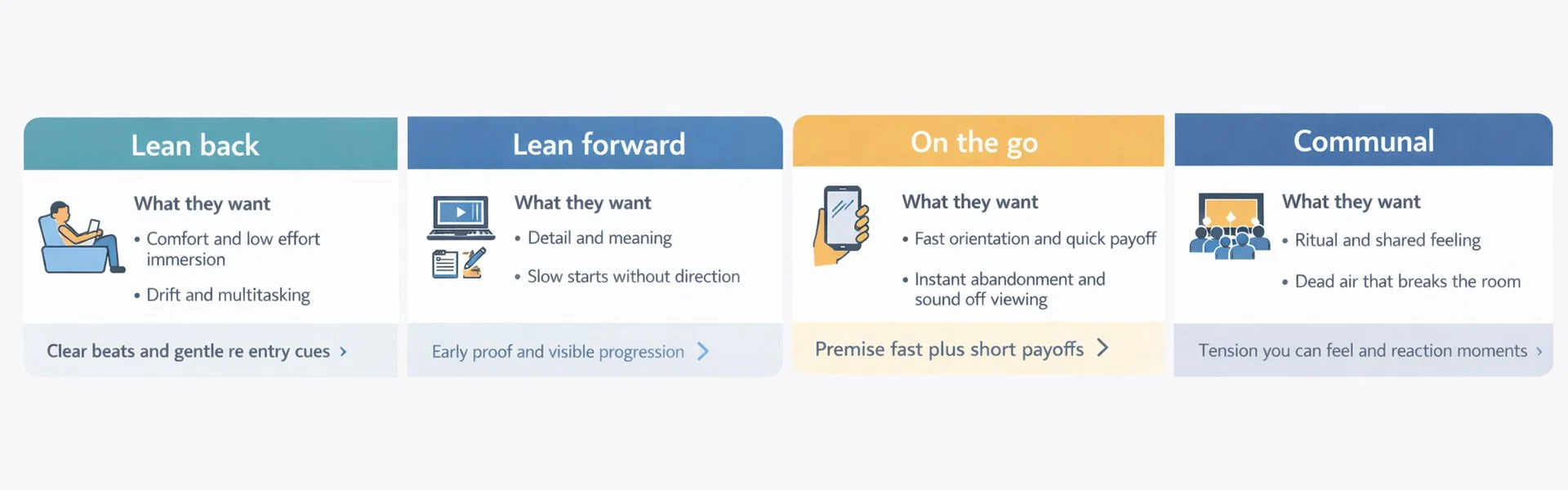
This matrix makes the contract concrete. The same person becomes a different viewer depending on posture and company, so it is more useful to pick a mode than to argue platforms. Use it to choose pacing, structure and emphasis that fit the way the story will actually be watched.
| Viewer mode | Typical setting | What they want | Main risk | Best craft move |
|---|---|---|---|---|
| Lean back | TV and sofa | Comfort and low-effort immersion | Drift and multitasking | Clear beats and gentle re-entry cues |
| Lean forward | Laptop, watching on purpose | Detail and meaning | A slow start with no direction | Early proof and visible progress |
| On the go | Phone, in a feed, often muted | Fast orientation and a quick payoff | Instant abandonment and sound-off viewing | Premise in the first seconds, short payoffs, captions that carry the story |
| Communal | Cinema or a shared watch at home | Ritual and shared feeling | Dead air that breaks the room | Tension you can feel and moments built for reaction |
The sound-off row is the one most briefs get wrong. I cover it properly in sound design and the spaces video lives in, and the captions side in how captions change what gets watched.
Quick definitions that make the map easier
If you are new to these ideas, this short glossary helps the rest of the post land. The definitions are deliberately plain so you can use them while planning or editing.
| Term | What it means | Why it matters on the job |
|---|---|---|
| Viewing contract | The deal the viewer thinks they are making with your film | When the deal is clear, viewers forgive rough edges. When it is not, polish does not save you |
| Viewer mode | How someone is watching right now, not which app they opened | Mode predicts pacing and sound needs better than the platform does |
| Re-entry | How easily a viewer picks the story back up after looking away | Real viewing is interrupted viewing. Good re-entry keeps them |
| Payoff | A moment that proves the promise you made at the start was real | Regular payoffs stop the film feeling like effort |
If you want an academic but accessible overview of film audience study across venues and methods, audience research reading list is a clean starting point that points to the field without becoming heavy.
The attention bargain when nobody is only watching
Attention did not disappear, it became negotiated. A lot of viewing happens alongside choice, interruption and parallel inputs, which means your work is constantly answering a silent question. Is this worth staying with right now? If your story cannot carry that question, it starts to feel like effort and viewers look for something that costs less to follow. If it can carry the question, the viewer protects it, even when the room is noisy and the day is busy. The irony is that the tools that free us from commitment can also make shared surrender rarer, because the exit is always within reach.
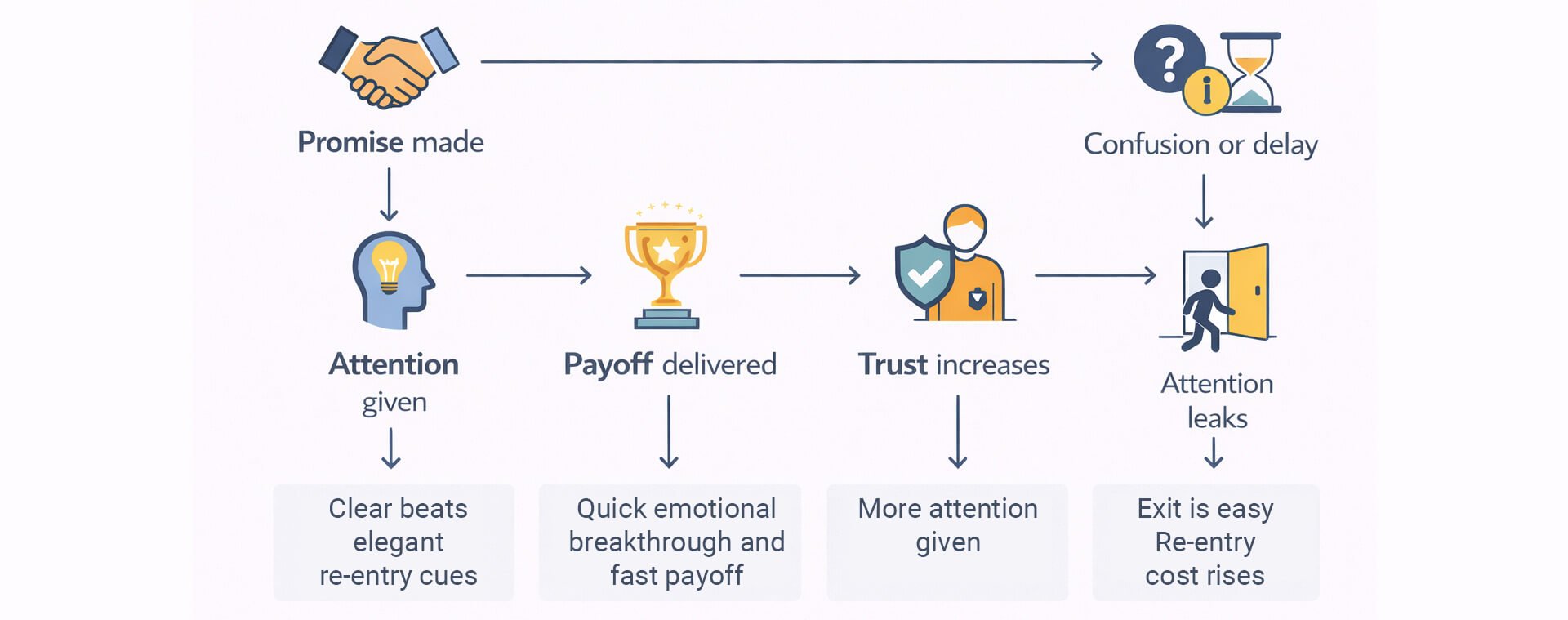
This is also where it helps to name the bargain directly, because it turns vague advice into a repeatable decision. How streaming rewired film rhythm frames attention as a trade you pay back with clarity, rhythm and proof rather than constant urgency.
A few signals that keep this grounded
In the US, streaming captured 47.5 percent of total TV viewing in December 2025, which is a useful reminder that switching and choice are not edge behaviours, they are the default environment for a lot of viewing, reported in streaming share of TV viewing.
Across US consumers, media and entertainment companies compete for an average of six hours per day of attention, and that number is not expanding, which is a simple way to understand why storytelling has to earn its place, captured in six hours of media time.
A US exhibition summary notes that moviegoing remains a mass behaviour, with 77 percent of Americans aged 12 to 74 seeing at least one movie in a theatre in the past year, according to the National Association of Theatre Owners, now Cinema United, in The Strength of Theatrical Exhibition, which is useful context when you want to talk about communal attention as a live behaviour.
If you want one UK anchor for global balance, the latest official figures are in UK cinema and production figures, which includes box office and admissions alongside production spend. The fuller picture of how viewing has split, updated as the figures move, lives in streaming vs cinema, how viewing has split.
These signals do not tell you what to make. They tell you what kind of room you are making it for, and why clarity and re-entry are no longer optional.
Second screens raise the price of confusion because a missed beat can turn into a lost thread. Experiments have found that second-screen viewing can increase cognitive load and reduce recall and comprehension, which is a useful directional reminder when you are deciding how much subtlety your structure can safely carry, in second screen cognitive load effects.
If you want to keep that idea practical rather than academic, the section on planning for the second screen below treats re-entry as a design problem rather than a complaint about phones.
The payoff ladder
This ladder keeps pacing honest and stops you relying on vague momentum. It also gives you a clean way to fix edits that feel flat, because it forces you to name what the viewer gets and when.
| Payoff | When | What it looks like | What it does for attention |
|---|---|---|---|
| Micro | Early | A clear promise and a reason to care | Cuts uncertainty, builds trust |
| Mid | Middle | A proof, a twist or an emotional lift | Rewards patience, renews momentum |
| End | Final stretch | A resolution or reframing that feels earned | Turns time spent into meaning |
The re-entry toolkit
Most people do not abandon a story because they hate it. They leave because they lost the thread and the cost of getting back in feels higher than the reward. Re-entry cues fix that without turning your work into constant recap, and they are especially useful when you are designing for viewers who pause, scroll or look away and then come back.
• Repeat the goal in new words
• Use visual anchors like a repeated object or location
• Add mini summaries disguised as dialogue
• Signpost turns, here is the problem and here is what changed
• Plant micro questions that pull the viewer back into curiosity
Viewing habits shift across contexts too, and streaming versus cinema trends frames those differences as behaviour and environment rather than audience labels.
Formats are behaviour, not packaging
Format is not just a look, it is a viewing posture. Vertical suits quick orientation and short payoffs. Widescreen suits settling in and building tension. A long take can feel hypnotic in a cinema and exhausting on a phone, not because it is wrong, but because it is mismatched to the viewing contract. The same logic applies to on-screen text. The caption style that lifts watch time in a muted feed is usually the one that wrecks comfort on a sofa, and a streaming caption that reads cleanly at distance can feel flat and slow in a scroll. When the format and the mode match, viewers stop noticing the container and start noticing the meaning, and that is the simplest definition of good format choice.
A useful reality check is that performance data is often incomplete or hard to interpret, which makes it easy to copy surface trends rather than understand why something worked. That dynamic is explored clearly in video demand and viewing data.
If you want a clean map of how aspect ratios, edits and distribution habits evolved together, how video formats shaped viewing habits frames it as behaviour change rather than a timeline of specs.
Production reality matters too. The phone is not only a screen, it is also a camera and a publishing tool, and MoJo magic, smartphone tips for stronger digital storytelling makes that advantage practical when speed and authenticity matter.
Start here · where will the first watch happen?
Phone
- Sound
- Usually off, in a feed
- Watch style
- Dipped into, interrupted
- Best move
- Premise in the first seconds, captions carry it, short payoffs
TV
- Sound
- On, but half-attended
- Watch style
- Lean back, may multitask
- Best move
- Clear beats and gentle re-entry cues
Laptop
- Sound
- On, often headphones
- Watch style
- Lean forward, on purpose
- Best move
- Early proof and visible progress
Cinema
- Sound
- Full, controlled
- Watch style
- Communal, one sitting
- Best move
- Tension you can feel and moments built for reaction
The first context predicts the sound, the sound predicts the watch style, and the watch style tells you the craft move.
Planning for the second screen
Most viewing now happens in two stages. The first room is where the story begins, the cinema, the sofa, the commute, the feed. The second room is where it gets resumed, shared, clipped, debated or ignored. Planning for both is less about optimising and more about protecting the experience when attention breaks.
Use this as a quick pre-flight before you lock the cut.
• Name the first room. Where do you realistically expect the first watch to happen, and what do viewers have, time, sound, screen size, patience?
• Predict the second room. If it travels, where does it travel to? A group chat, a living-room rewatch, a short clip, a reaction, a classroom?
• Decide what must survive. If someone misses 15 seconds, watches sound-off or drops in halfway, what single idea still lands?
• Build a clean re-entry point. Add a moment that re-orients without repeating. A visual reset, a line that restates the stakes, a clear turn.
• Choose the shareable unit. If one fragment represents the whole, what is it, and does it reflect the intent rather than distort it?
The goal is not to make everything platform native. It is to make the work resilient. Clear when watched imperfectly, and still rewarding when watched properly.
A format decision checklist
Before you lock anything in, answer these without hedging, because vague answers usually turn into vague edits.
• What is the first viewing context, phone, TV, laptop, cinema?
• What is the likely second context after sharing?
• Is this watched in one sitting or dipped into?
• Is sound likely to be on or off?
• What single thing must still be understood if 15 seconds are missed?
Overused defaults and better alternatives
These defaults are common because they work in short bursts, but they get overused and flatten meaning. Use this as a quick quality filter when an edit feels busy but not memorable.
| Trend | What it did well | Why it stopped working | What to do instead |
|---|---|---|---|
| Constant urgent pacing | Held attention in short bursts | No contrast, so nothing lands | Speed up for steps, slow down for meaning |
| Generic montage openers | Quick polish and momentum | Delays meaning and feels interchangeable | Open on a specific moment of friction or result |
| Kinetic typography overload | Clarity in noisy feeds | Text becomes the story instead of supporting it | One line at a time, then clear it |
There is a longer list, including glitch transitions, speed ramps and the teal-and-orange grade, in the techniques everyone is using and what to do instead.
Interactivity and AI are changing what watching means
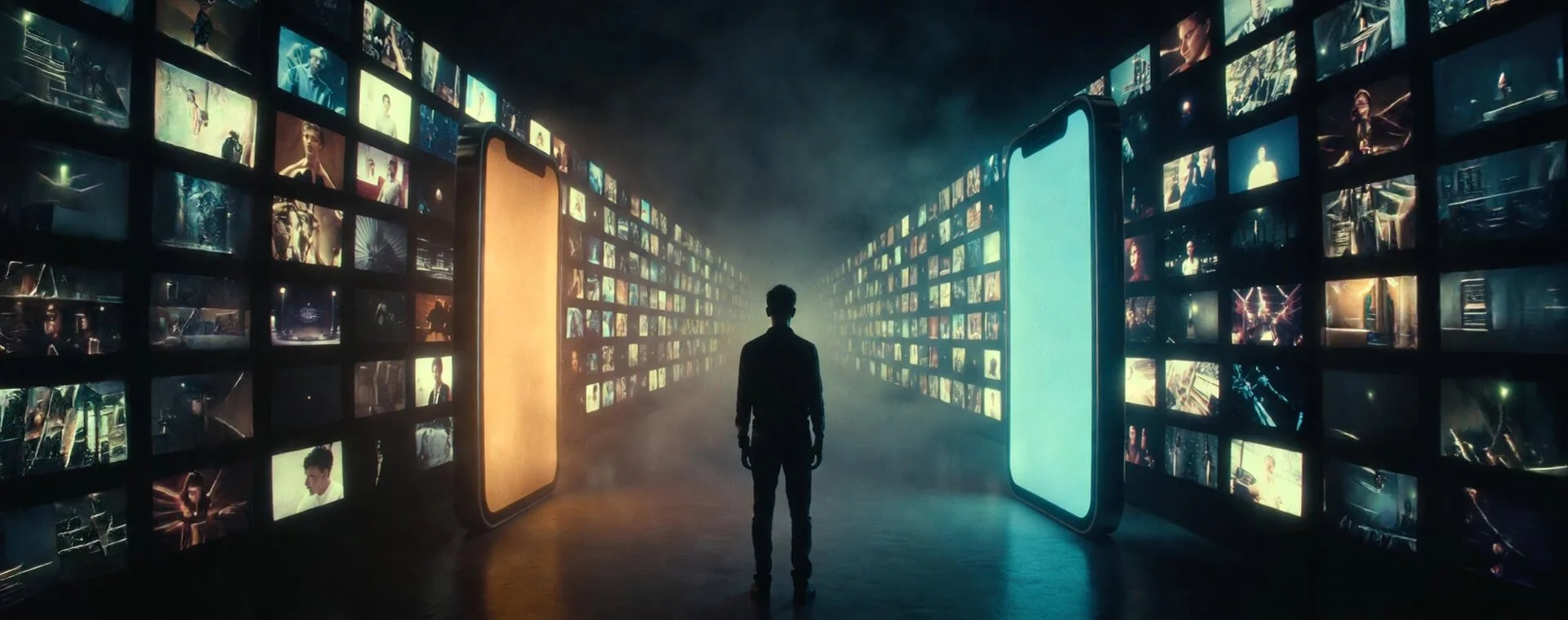
Watching used to be mostly one way. Now audiences often expect some form of participation, even if it is light. Participation can be social, structural or commercial, and the key question is whether it strengthens meaning or competes with it. If participation clarifies the promise, it can raise attention because the viewer feels included rather than sold to. If participation becomes the main event, the story becomes decoration and the contract gets muddy. This is why the best interactive ideas feel invisible. They make the work easier to stay with, not harder.
A clear modern example is commerce inside the viewing flow, where watching and deciding happen in the same moment. The far end of the same shift is video that is generated as it plays, which I look at in live generative video.
If you want an accessible framing of communal watching as a social experience, films as social glue is a useful human layer that pairs well with the research on shared emotion.
Trust rules that keep your work credible
I now make generated work as well as filmed work, and the four viewing modes have not moved an inch. What moves is trust. If you want this to stay useful and credible, treat trust as part of craft, not an afterthought. The simplest check is whether the interactive or generated layer clarifies what the viewer is meant to feel and understand, or whether it distracts from it. It also helps to separate speed from meaning, because a faster workflow is not the same thing as a stronger viewing contract. AI does not sign the contract. Clarity and trust do.
• If participation clarifies meaning, it strengthens the contract
• If participation competes with meaning, it weakens the contract
• If AI is used, be clear about it where clarity matters, especially if something could mislead
• Keep a human editorial layer for premise, ethics and final judgement
What happens to the viewing contract when the audience cannot tell what was filmed and what was generated is the subject of the next pillar, the real blackout in AI video is trust.
What to plan with
If you want a practical way to plan film and video that people actually finish, start here. The viewer signs a contract even if they never name it. Attention is a trade you pay back with clarity and rhythm. Format is behaviour, not packaging, so choose posture first. Agency is powerful when it serves meaning, not when it shows off. Re-entry is craft, so design for interruptions rather than pretending they will not happen.
A short playbook you can reuse
1. Write the contract in one sentence
2. Choose the viewing mode from the matrix
3. Pick the format that matches that mode
4. Place your micro payoff, mid payoff and end payoff
5. Add two re-entry cues
6. Remove one moment that does not serve the promise
Questions people actually ask
Do you need to choose between cinema and streaming?
No. Choose based on the contract you are offering. Cinema is high-commitment attention when the event is worth it, and streaming is lower-friction attention that has to survive interruption.
Is shorter always better now?
No. Clearer is better. Long form can win when the contract is clear and payoffs keep arriving. Long form can be a feature film, a documentary or a full-length podcast episode, while short form is closer to a highlight reel, a trailer cut or a TikTok-sized story.
How do you stop a film feeling like homework on a phone?
Make the promise legible fast, keep micro payoffs frequent, and design re-entry points so missing a short moment does not break the thread.
Does any of this change if the video is AI-generated?
The viewing modes do not change. What changes is trust, because the viewer may not know whether they are watching something filmed or something generated, and that uncertainty affects how much they give you. That is where the real blackout in AI video is trust picks up.
Where to go next
Intrigued by any of these? Each one goes deeper on a part of the map.
| Read next | Best for | Who it is for |
|---|---|---|
|
|
The data behind everything on this page, kept in one place and updated | Anyone who needs to justify a format or release decision with figures |
| How streaming moved the payoffs earlier and what that does to structure | Writers, editors and directors cutting for a second-screen audience | |
| Mixing for headphones, phones, sofas and public screens where nobody listens properly | Directors, editors and sound designers | |
| Why the viewing contract starts before the play button, and how to write the promise into the frame | Anyone publishing to a feed or a platform library | |
| Making the on-the-go row of the table actually work | Comms and social teams, solo shooters | |
| Applying the viewing contract to a branded documentary, from interview to delivery | Brand and commissioning leads, producers, agencies | |
| Which craft choices travel across platforms and which are trend-chasing | Creators and commissioners choosing duration, framing and home | |
| Making phone-shot work feel deliberate for an audience already scrolling | Solo shooters, comms teams, students | |
| What happens to the viewing contract when the audience cannot tell what was filmed and what was generated | Anyone commissioning or making AI-assisted video |
Before you go
If you are planning a piece and the question is which room it needs to work in, or whether it should be shot or generated, that is the conversation I have with teams before a brief goes anywhere near a crew. Here is how that works, or get in touch with a sentence or two about the project. Teams who want to build this thinking in-house can look at the workshops.