The Attention Bargain: How Streaming Rewired Film Rhythm
Last updated: May 7, 2026
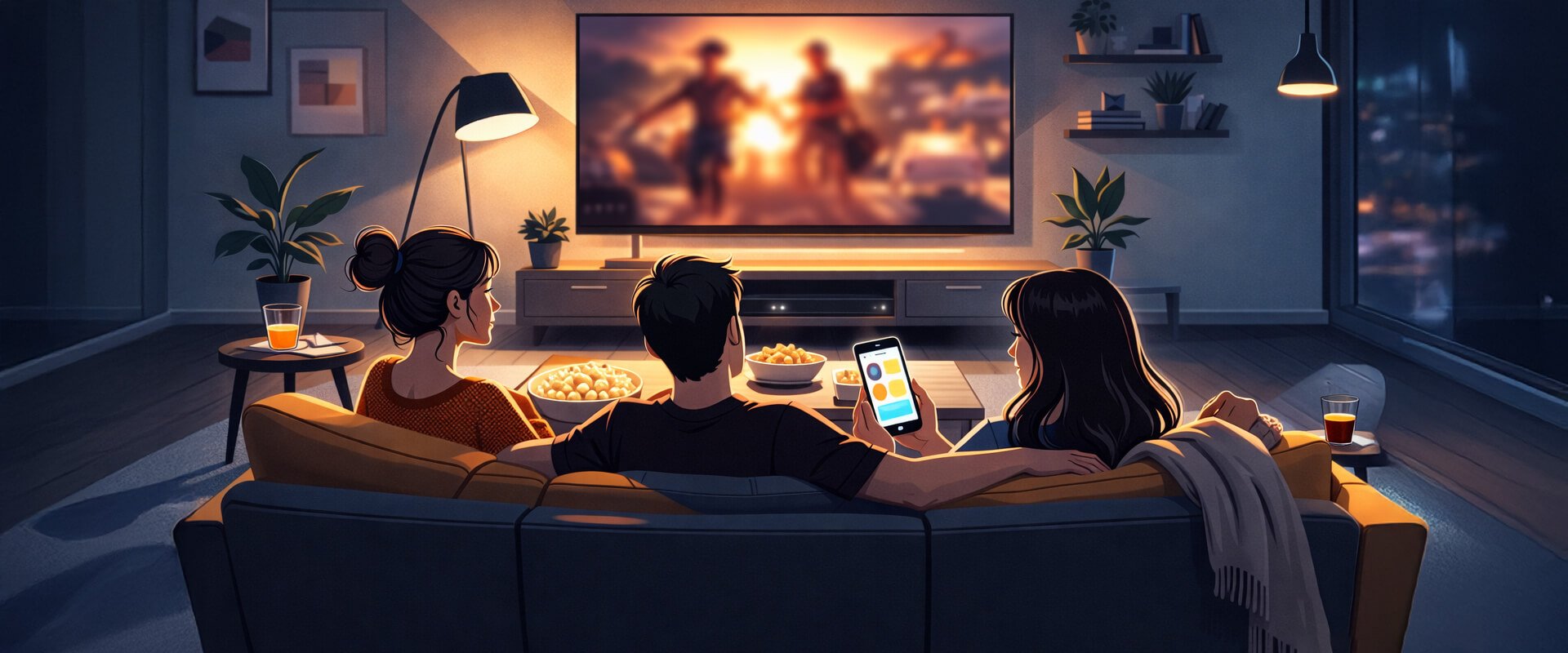
You settle on the sofa for what you hope will be a proper watch. Twenty minutes in, your phone lights up. Without thinking you pick it up, scroll for thirty seconds, and when you look back the story has already moved on.
Do you rewind, or do you just carry on and accept you missed something important?
That split-second decision is the attention bargain in action.
That moment hits hard. You sit down to watch something you were genuinely excited about, only to realise you had picked up your phone without thinking and missed a key moment. The story did not fail. The contract did.
Attention did not disappear overnight. Many of us have traded it willingly for the privilege of watching whatever we want, whenever we want, with as little commitment as possible. Streaming platforms did not kill patience. They found ways to profit from impatience, then quietly rebuilt viewing and storytelling around it.
The result is a rhythm designed for easy exits: faster starts, quicker payoffs, and fewer stretches where a film simply asks you to sit with it, in a world shaped by where video lives now.
| Era | Viewing setup | Attention bargain | Rhythm impact |
|---|---|---|---|
| Radio and early TV (1930s to 1950s) | Whole family around one speaker or small screen, fixed schedule | Full focus or nothing. You committed or missed the whole thing | Slow build, long scenes, dialogue that rewarded listening |
| Colour TV, limited channels (1960s to 1980s) | One living-room set, no pause, no rewind | Sit through the ad break or lose the thread | Act breaks every 12 to 15 minutes, cliffhangers designed to hold you |
| Cable and early VHS (1990s to 2000s) | Hundreds of channels, first pause and rewind possible | You could leave and come back, but you still watched in one sitting | Longer takes and more breathing room, with shot length varying widely by genre and director |
| Early streaming (2010s) | On-demand, autoplay, skip intro | Start or stop instantly. Patience became optional | Cold opens, quicker hooks, fewer unbroken stretches before a payoff |
| 2026 mobile-first streaming | Phone in hand, second screen always present, endless choice | You give attention in tiny fragments. Story must earn every glance back | Clear re-entry points, visual anchors, and fast re-orientation when attention snaps back |
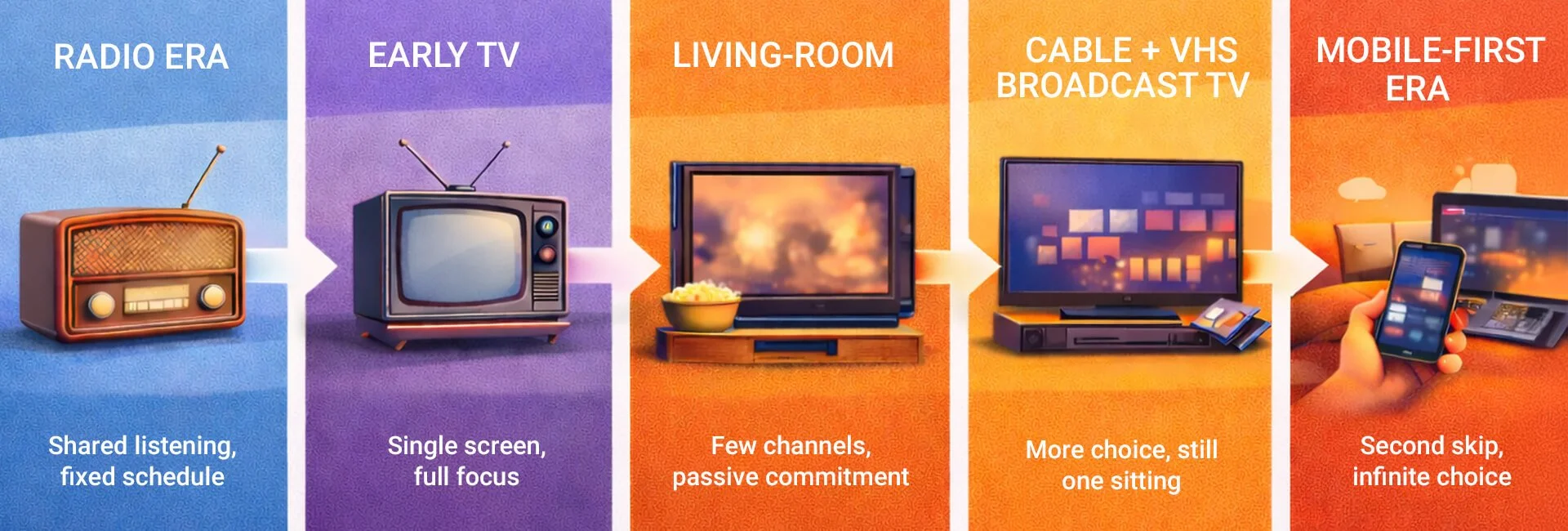
How viewing environments shifted from shared schedules to mobile-first viewing, and reshaped the attention bargain.
The second screen does not just distract
There used to be an older contract in cinema, and for a time in television too. You gave the story your full attention and it gave you immersion in return. Distraction existed, but it stayed outside the experience. A cough. A late arrival. The rustle of sweets. Leaving felt like an actual decision.
Now the second screen sits inside the experience. A film competes with notifications, feeds, messages, and the simple relief of switching tabs. At home you manage a menu while you watch. Even in cinemas the phone glow has become familiar, not because people forgot etiquette, but because the habit follows us into every room. Attention is no longer assumed. It is constantly renegotiated.
Convenience won. It is hard to argue with the comforts it brought. Yet convenience always rewrites the rules. When departure becomes effortless, stories have to adapt.
The cinema problem isn’t only competing screens. It is behaviour inside the room. Phone use and chatter are now regularly cited as reasons people stay away, because they break the very thing cinema still sells best, shared commitment. It is hard to police at scale, and once immersion stops being protected, the case for watching at home gets stronger. The complaint is mainstream enough that Scorsese on audience bad behaviour in cinemas has become part of the conversation.
And that is the environment streaming is built for. When attention arrives fragmented and departure is effortless, platforms reward stories that reduce confusion, shorten the distance to payoff, and make it easy to re-enter after a glance away.
How streaming rewired rhythm and payoff
People like to treat Netflix original programmes as the turning point. A better explanation is that Netflix industrialised continuation. It made starting easy, then made stopping feel slightly abnormal.
Even the artwork plays its part. Thumbnails reduce hesitation and increase the chance of a click, often by testing different versions of the same title. The goal is speed. Remove the pause between maybe and play and you win the moment.
Then comes the interface. Autoplay. Skip intro. Recaps. The gentle slide into the next episode. These features get defended as simple convenience, but convenience has direction. The platform does not need to convince you a show is great. It only needs to keep you from leaving long enough for the show to hook you on its own terms.
This changes the value of patience. When platforms optimise for continuation, any lull becomes expensive. Stories compete. Even if Netflix fades, the logic stays. Any platform built on retention will keep compressing the distance between impulse and payoff. This isn’t only Netflix. Prime Video, Disney Plus and the rest compete in the same attention marketplace. The surface details differ, but the incentives rhyme.
Open many recent streaming thrillers and you land mid-problem almost immediately. Cold opens. Early hooks. Cliffhangers arrive quickly, sometimes well before the midpoint. This isn’t cynicism. It is adaptation to a world where viewers can leave at any moment and platforms benefit when they do not.
You see it clearly in average shot length, or ASL. This is the average amount of time each individual shot stays on screen before cutting. Large-sample research shows shot durations in popular cinema have generally shortened over time, although the range is still wide and genre does a lot of the work.
Short snappy clips on TikTok, Instagram Reels and YouTube Shorts add another pressure. They train audiences for frequent micro-rewards. A short-form video meta-analysis on attention found that higher engagement is associated with poorer attention and reduced inhibitory control. That does not prove causation on its own, but it does describe the direction of travel.
Behind much of this acceleration sits reward design. Platforms and creators have wired content for rapid reinforcement and fast re-engagement. A research-grounded way to talk about dopamine here isn’t dopamine as pleasure, but dopamine-linked learning signals that update expectations through reward prediction error.
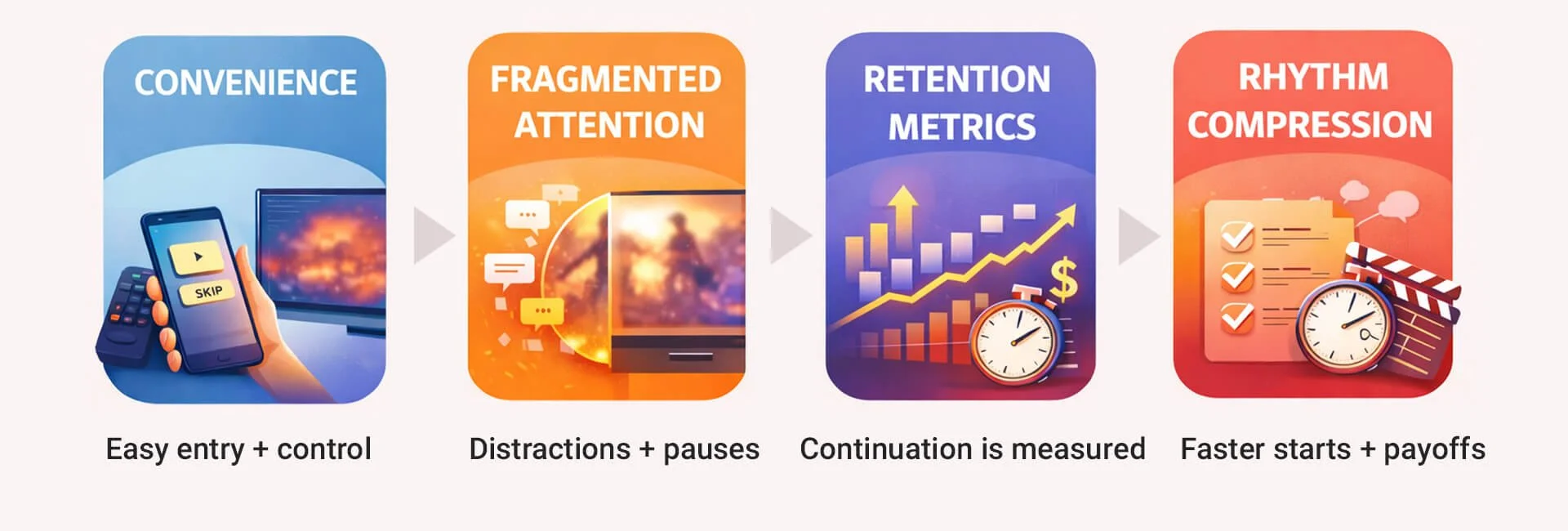
How streaming convenience reshapes attention and compresses storytelling rhythm.
What Next?
Filmmakers and showrunners are already adapting to the attention bargain without turning everything into noise. The patterns that travel best on subscription platforms are less about constant speed and more about reducing friction, strengthening re-entry, and placing meaning where distraction is most likely.
| Platform pattern | What it does well | Why it gets rewarded | What to do instead |
|---|---|---|---|
| Problem first openings | Gives the viewer a question to hold on to | Early drop off is costly and clarity buys minutes | Open on a specific disturbance, then earn depth with detail |
| Skip friendly titles | Keeps momentum and avoids slow ramping | Many viewers skip long intros | Make titles short, purposeful, or story loaded rather than ornamental |
| Recap aware structure | Helps viewers re-enter fast after a gap | Platforms want frictionless returns | Build one clean through line per episode, avoid repeating every beat |
| Re-entry anchors | Makes it obvious where you are after distraction | Second screen viewing is common | Use clear goals, distinct spaces, and repeating motifs, not extra exposition |
| Compressed payoff cadence | Delivers small resolutions before impatience hits | Progress that feels frequent supports continuation | Let micro payoffs deepen theme or character, not just add noise |
| Episode end turns | Creates an impulse to continue | Low friction continuation turns curiosity into minutes watched | End on a meaningful change in stakes, not a cheap interruption |
| Legibility first coverage | Keeps faces and emotion readable under partial attention | Re-entry is easier when scenes are instantly legible | Keep legibility, then earn contrast with one distinctive choice per sequence |
What we lose and smarter approaches
This isn’t an argument for slowness as virtue. Some slow films are frankly indulgent. Yet slowness used with intent can hold things speed struggles to carry. Creeping unease. Moral ambiguity. The weight of silence. Atmosphere that accumulates rather than hits.
Think of Tár if you have seen it, or picture the kind of drama it represents. Cate Blanchett plays a celebrated conductor whose authority begins to unravel under scrutiny. Much of the tension comes from what isn’t said, and from how long the film is willing to sit in a room and let power dynamics do the work. Try that exact approach in a retention-optimised series and a meaningful share of the audience will have checked their phone before it lands.
When storytelling is built around retention, those spaces get squeezed. Nuance becomes riskier. Subtext often gives way to explanation. Emotional texture gets traded for plot propulsion because plot is easier to measure. Minutes watched can be counted. The slow build that makes someone lean in without knowing why is harder to measure.
Many streaming shows also converge on the same visual language. Brightly lit rooms, oversaturated colour, and frequent reaction shots keep emotions legible even when attention wavers. It helps re-entry, but it can flatten distinction. This pressure now spills into theatrical releases too, as studios push films that must work on both a big screen and a sofa. On streaming platforms that often becomes more attention hits and less depth, as explored in what the Netflix algorithm has done to our films.
The same pattern shows up in music and sound design. Choices that once built genuine emotion over time, long ambient beds, subtle soundscapes, gradual builds, can lose out to fast signals that keep the viewer oriented. Risers, whooshes and emotional stingers grab attention, but used too often they start replacing the scene rather than serving it.
So where is this headed? Streaming will keep rewarding stories that are easy to restart, easy to follow mid-scroll, and quick to prove they’re worth another minute. That pushes rhythm towards clearer entry points, faster orientation, and more frequent moments that confirm progress. The attention bargain keeps tightening the loop between impulse and payoff, and that loop shapes pacing decisions long before a scene is shot. The risk isn’t that films get shallow by default, it’s that the same hook tactics become the default. When every episode uses the same tools to hold attention, cold opens, recap beats, cliff turns, constant score lifts, the rhythm starts to feel interchangeable. The craft challenge is to use those tools with intent, then break the pattern often enough that something can still land.
Key takeaways to use right away
Treat attention as something you negotiate, not something you assume.
Faster hooks help discovery, yet over-compress payoff and you risk interchangeable stories.
Build in space for breathing and silence when it serves the emotion.
Test edits with real second-screen distractions to see what actually survives.
Remember the big screen still delivers the older, deeper bargain when you want it.
Streaming did not destroy attention. It monetised impatience, then redesigned storytelling to match the new terms. Whether that counts as evolution or erosion depends on what we choose to watch and how often we let a story ask more of us than a thumb can tolerate.
Frequently asked questions
Many readers ask how streaming platforms shape storytelling choices in practice. The questions below address the most common concerns.
What is the attention bargain in streaming?
The attention bargain describes the trade audiences make when using streaming platforms. Viewers gain instant access, control and convenience, but in return their attention becomes fragmented. Because it is so easy to pause, switch or leave, platforms reward stories that reduce friction, shorten the time to payoff and make it easy to re-enter after distraction.
How has streaming changed film rhythm?
Streaming has shifted rhythm towards faster orientation and clearer structure. Stories often introduce conflict earlier, deliver more frequent micro-resolutions and use visual cues that help viewers understand what is happening even if their attention briefly wanders. This does not necessarily mean everything is faster, but it does mean uncertainty and long build-ups have become riskier.
Why do streaming platforms favour quicker payoffs?
Subscription platforms measure continuation and engagement. If viewers leave early, the system treats that as a negative signal. As a result, storytelling patterns that prove value quickly, establish stakes early and provide regular progress tend to perform better in recommendation systems.
Does streaming make films more shallow?
Not automatically. The real risk is not depth disappearing, but default pacing tools becoming overused. When every story relies on the same hooks, recaps and constant tension cues, rhythms can start to feel interchangeable. Depth still emerges when creators use those tools selectively rather than constantly.
What is “re-entry” in modern storytelling?
Re-entry refers to how easily a viewer can understand a scene after looking away. In streaming environments where second-screen behaviour is common, stories often include clear visual anchors, simple goals and quick reminders of context so audiences can reconnect without rewinding.
Why is the cinema experience different from streaming?
Cinema still operates on a shared attention contract. Viewers agree to focus together for a set period, which allows slower pacing, longer takes and sustained atmosphere to work more effectively. Streaming, by contrast, assumes attention may be interrupted at any moment, so it favours clarity and frequent reinforcement.