3 Storytelling Moves for Brand Video Impact

Think about the last brand film watched to the end. What made it worth finishing? Most pieces lose attention early because the purpose is not clear fast enough.
Most marketing films do not fail because the footage is weak. They fail because the viewer cannot tell what this is, who it is for, and why it matters quickly enough. People scan fast on the web, so meaning needs to show up early.
“Drama is life with the dull bits cut out.”
These choices work best when they stay consistent across the whole film. Making video feel real shows how to carry the same intent through pacing, sound, and detail from the first seconds to the last.
Why brand films often miss
Most drop offs happen early. That makes the opening a clarity test, not a warm up.
A common pattern shows up in event highlight edits. The coverage looks polished, but the viewer is missing one or two grounding cues. What the event was for, who it served, and what the theme was. Without that context, the moments can feel interchangeable even when the production is strong.
Here are the most common failure points, and what to change.
| Why it misses | What it looks like | Common scenario | What to do instead |
|---|---|---|---|
| Meaning arrives late | Slow montage or drone shots before the point is clear | A property promo runs 10 to 15 seconds of skyline shots before any people, offer, or proof | Signal what this is in the first moments, then earn the beauty shots |
| One piece tries to speak to everyone | Multiple audiences and benefits stacked together | An explainer lists audiences and features before one viewer job is clear | Choose one viewer, one job, one main objection, then build proof |
| Claims show up without proof | Trusted, premium, innovative language over generic visuals | A film says trusted by leaders while showing meetings with no case detail | Replace claims with something visible, process, demo, before and after, customer voice |
| Highlights with no through line | Nice moments stitched together with no clear change | An event reel shows crowds and speakers, but never says what the event was for | Add one grounding line early, then choose moments that prove it |
| Sound is treated as wallpaper | Music carries emotion while speech is thin or unclear | A product film looks polished, but key lines are hard to hear and room tone shifts | Treat sound as clarity, clean voice, intentional pauses, one chosen moment of texture |
| The next step is vague | Inspiring ending with no clear action | A recruitment film ends with hiring language, but no roles, fit, or where to go next | End with one next step that matches the viewer job |
The table above is the pattern. The fixes below are the decisions that prevent those misses. Start with the viewer, then shape the story arc, then choose an opening that earns attention fast.
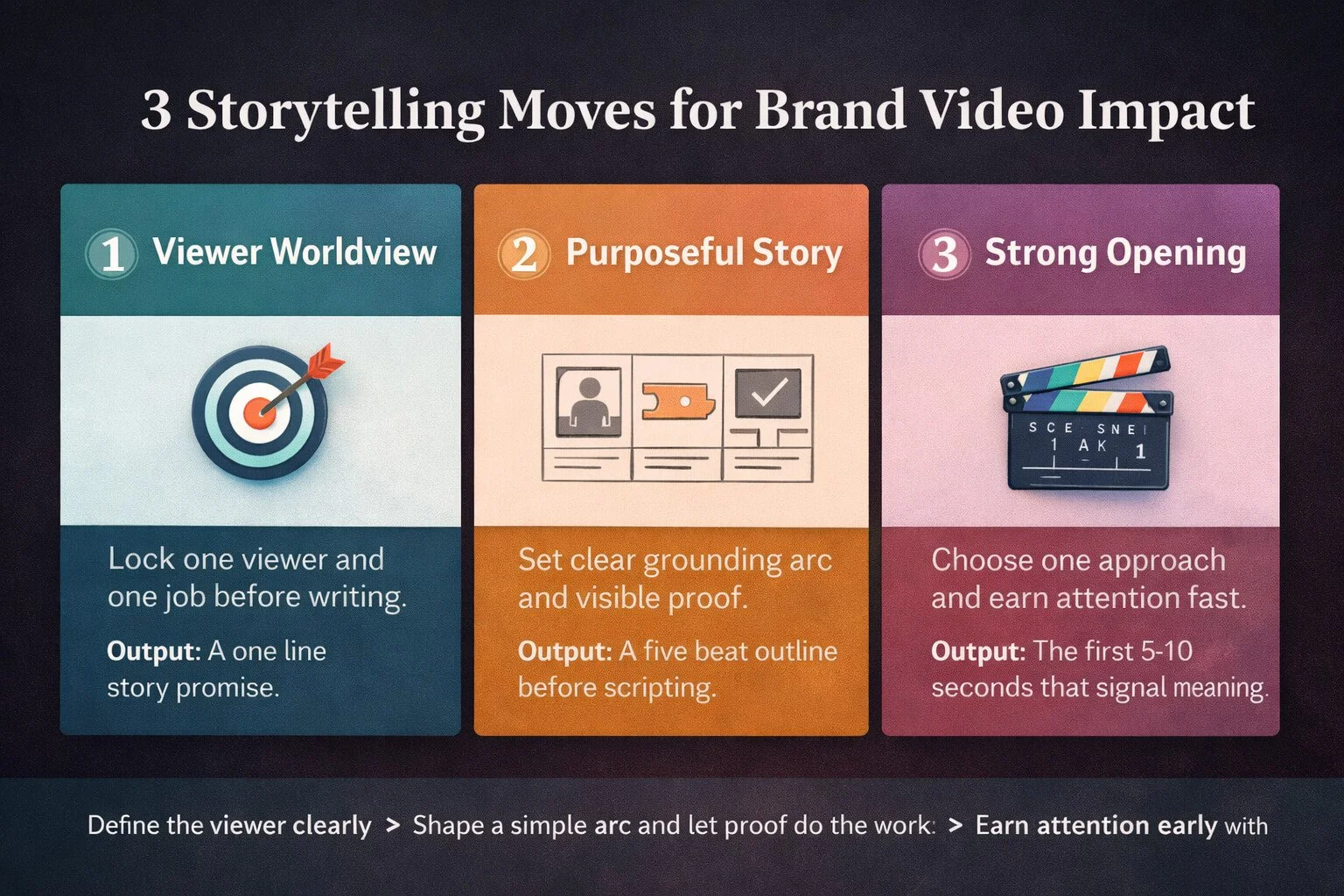
Use the three moves in order. The first locks who the film is for, the second gives the story a spine, and the third earns attention early so the viewer stays long enough to feel the point.
1) Understand the viewer worldview
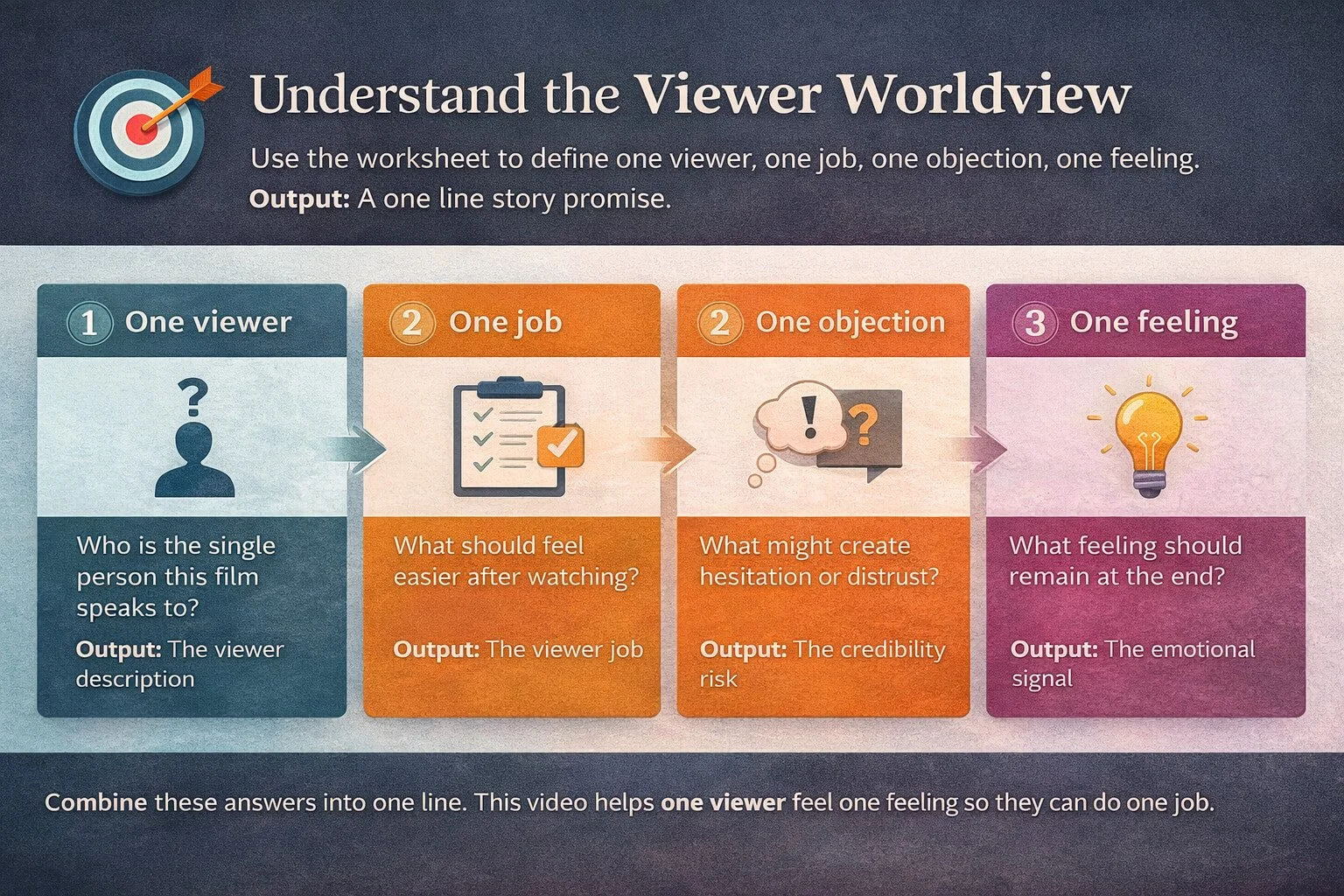
This step prevents vague scripts by locking one viewer and one job before writing.
Storytelling starts before the script. It starts with the viewer priorities and constraints.
A brand manager may need clarity and confidence. A founder may need a story that sounds like the business. A buyer may need to picture themselves inside the outcome. The right story changes based on who is watching.
Use this quick worksheet before writing anything. It keeps the viewer, purpose, and proof clear before the script expands.
| Worksheet prompt | Question | Why it matters | Output |
|---|---|---|---|
| One viewer | Who is the single person this film speaks to? | Keeps language specific and stops the message drifting | A one line viewer description |
| One situation | Where will they watch it, landing page, pitch deck, social? | Context changes pacing, proof level, and what needs to be said first | A single viewing scenario |
| One job | What decision should feel easier after watching? | Gives the story a purpose beyond impressions | One outcome the film supports |
| One objection | What might create hesitation or distrust? | Helps plan proof so the film does not rely on claims | One credibility risk to address |
| One feeling | What should remain at the end, reassured, curious, ready, proud? | Emotion is the glue that makes the message stick | One feeling word to test drafts against |
Turn that into a simple story promise by using one line as the anchor for the whole piece. This video helps one viewer feel one feeling so they can do one job. If that promise cannot be said cleanly, the story usually cannot be cut cleanly.
2) Craft a purposeful story with impact
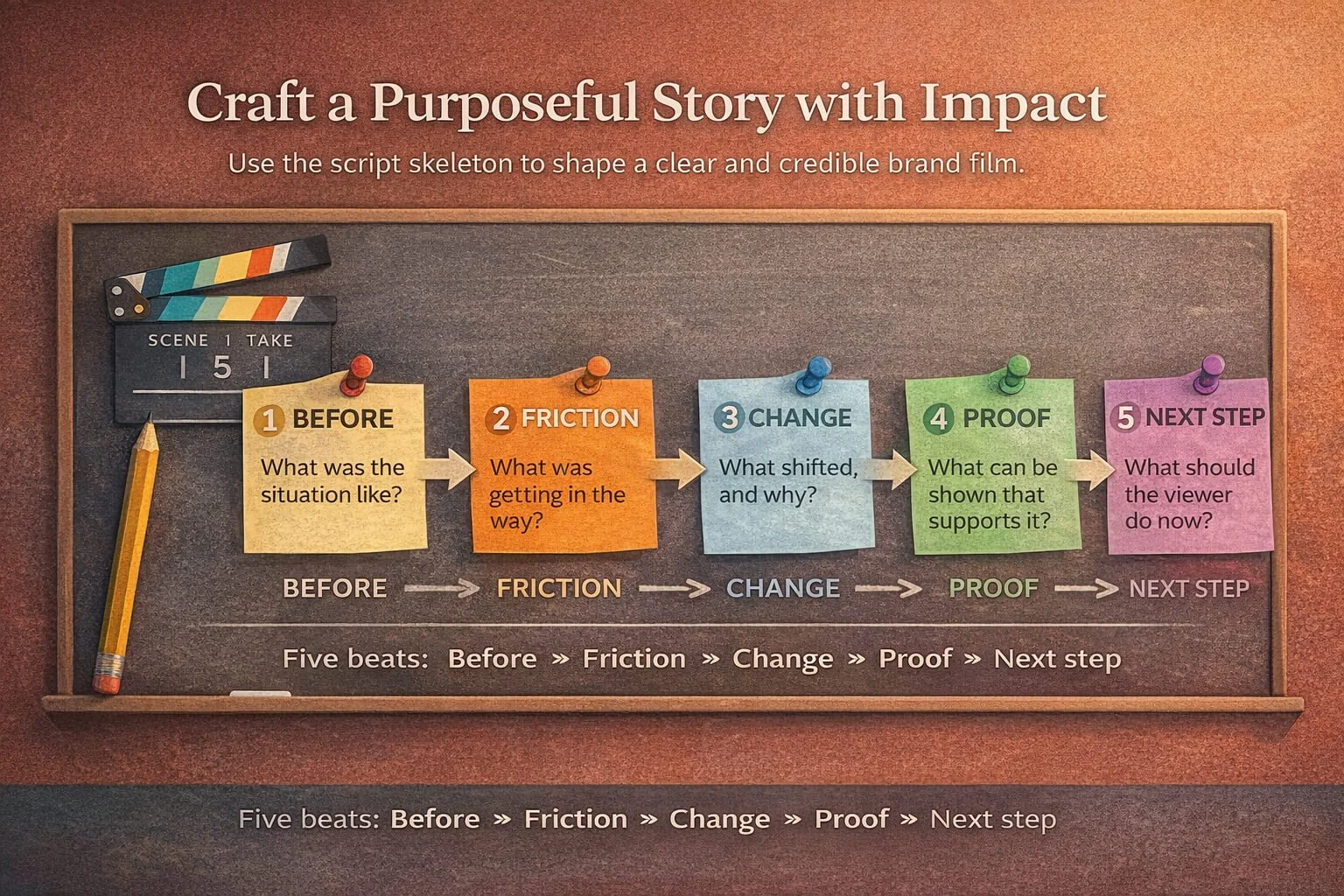
This step keeps the edit from becoming a highlights reel by giving the story a simple spine.
A purposeful story does not need drama. It needs structure that supports meaning.
A reliable arc for brand work often fits this shape.
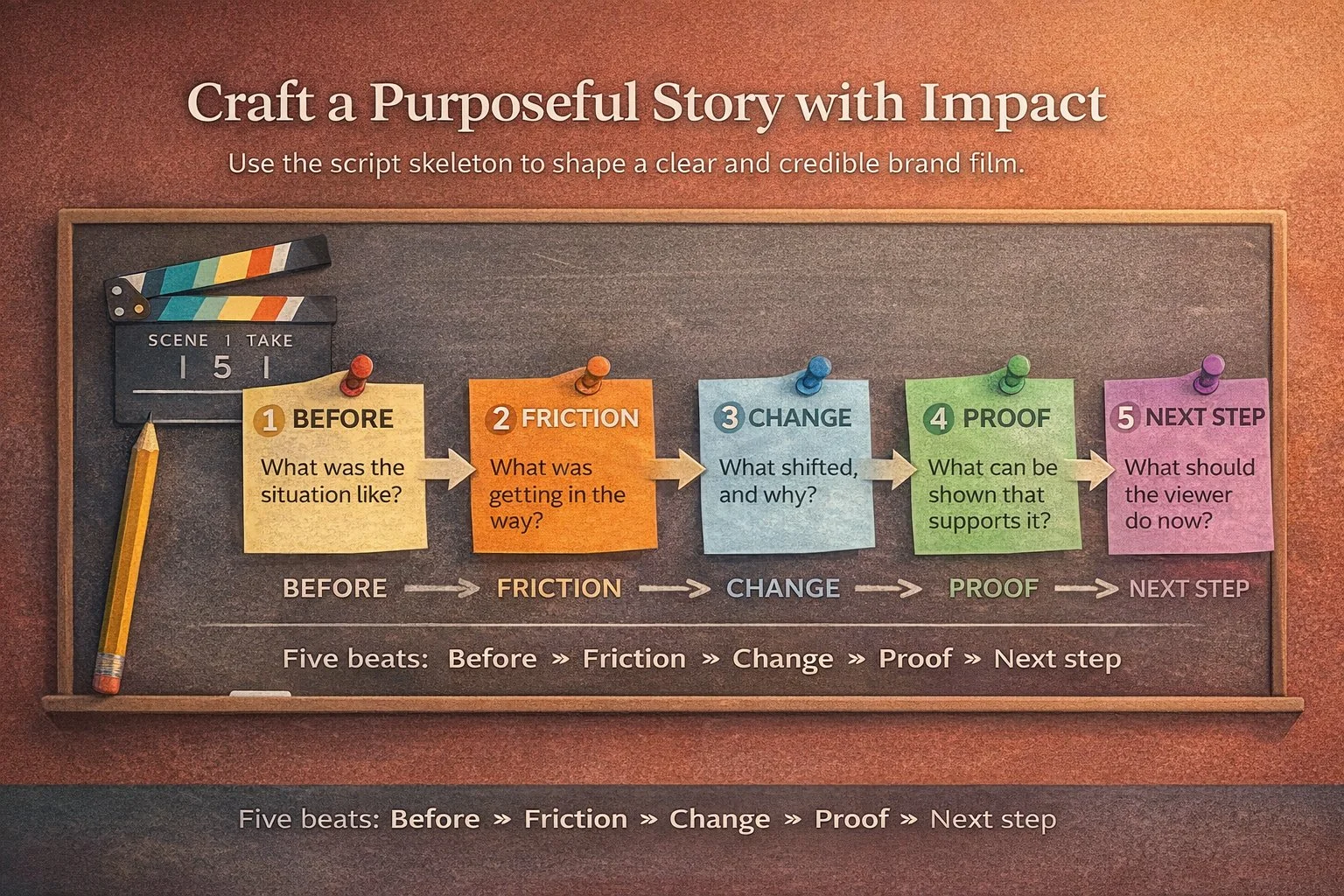
Before → friction → change → proof → next step
A practical script skeleton
Write these five beats as single sentences first, then expand.
Before
What was the situation like?Friction
What was getting in the way?Change
What shifted, and why?Proof
What can be shown that supports it?Next step
What should the viewer do now?
If proof is not planned, the story is asking the viewer to believe instead of showing them why.
A quick note on production value
Polish helps, but clarity carries the weight. A simple setup can outperform a complex shoot when the message is specific and the proof is visible.
3) Start strong and build emotional connection
This step earns attention early by choosing one opening approach and committing to it.
A good opening does two things fast. It tells the viewer what this is and why they should keep watching. Pick one of the opening types below and build the first 5 to 10 seconds around it
| Opening type | What it does | When it works best | Example line |
|---|---|---|---|
| The moment | Starts on the result, then steps back to explain how it happened | When the outcome is visual and easy to understand | This is what changed after the switch |
| The friction | Shows what is not working, so the viewer feels the need for change | When the pain point is familiar and specific | Three tabs open and still no clear answer |
| The promise | States the outcome plainly, then backs it up with proof | When the benefit is simple and measurable | Here is how the process became simpler without extra steps |
| The contrast | Shows before and after quickly, then explains the difference | When the transformation is easy to see | Before was messy, after is clean |
| The human detail | Uses a small real moment to signal truth and draw attention | When trust and credibility matter more than spectacle | A pause before the answer says more than the script |
Emotion is not decoration. It is built through close detail, pacing, and sound that supports the point. When the story is clear, those choices multiply the impact.
Summary of insights
These three moves are the decisions that shape everything that follows.
Define the viewer clearly
Shape a simple arc and let proof do the work
Earn attention early with a clean opening
Key takeaways
| Move | What to decide | What to produce |
|---|---|---|
| Viewer worldview | One viewer, one job, one objection | A one line story promise |
| Purposeful story | Before, friction, change, proof, next step | A five beat outline before scripting |
| Strong opening | Choose one opening type | The first 5 to 10 seconds that signal meaning |
Next step to apply this fast
Good storytelling does not require a big budget. It requires clarity.
A useful next step is to take one existing script and run it through the worksheet and the five beat outline. If the promise line cannot be said in one breath, tighten it before filming. If proof cannot be shown on screen, change the claim.
people in a particular way.