
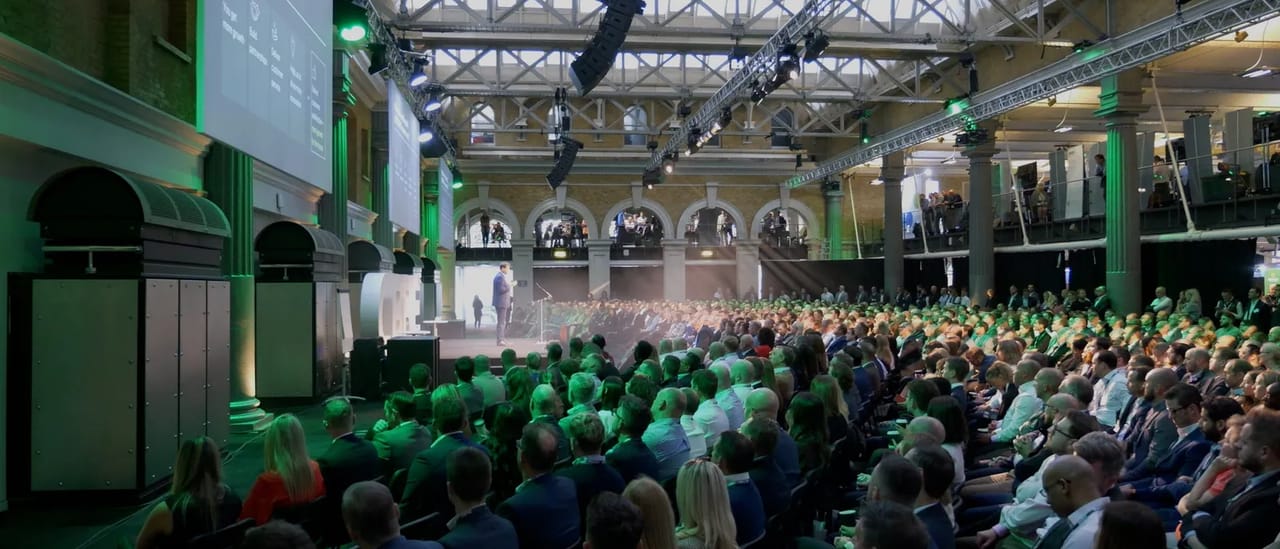
A London room can look perfect in the brochure and still be a poor place to film. I start by asking what the finished film has to do once everyone has gone home, and I judge the space against that.
I've been filming since 2011, from wildlife to boardroom events, and the same problems keep turning up: an air conditioner humming under every speech, and a presenter pacing in front of the slides. This is how I judge a space when a corporate event needs to work on camera, not only in the room.
The wider plan for the day, and what the coverage is for, is in how to plan event filming in London for video coverage that works. This post is the location half of that.
In this guide
- What should the film achieve before you book the venue?
- What should I check before the venue is booked?
- Where can the cameras go, and what's in the background?
- Which London spaces have I filmed at?
- When should you visit the venue?
- What questions should I send the venue?
- Common questions about filming a London corporate event
- If you're booking now
What should the film achieve before you book the venue?
Decide what the finished film has to do, then choose a room that can support that, not the other way around. Booking a handsome space and then asking the footage to do everything is how you end up with empty-looking highlights, interviews next to a coffee station, or a keynote with no usable sound. The film is what most people who weren't in the room will ever see, so ask these questions before anyone signs.
| What the film has to do | What I look for in the room |
|---|---|
| A conference highlight reel | A room that still looks occupied at your likely numbers, sightlines for at least two camera angles, and a clean desk feed. |
| A keynote or speaker recording | Even light on the podium, blinds or blackout, a presenter position that doesn't sit in front of the slides, and a reliable desk feed. |
| Interviews or testimonials | A quiet, separate room on the booking, with a simple backdrop and power. Not a corner by the coffee. |
| A networking film | Space where people actually gather, ideally on one level, and a background that still looks clean in a wide shot. Split floors thin the crowd. |
| Short social clips | A few uncluttered backgrounds you can use quickly between sessions, and enough light to work without a big set-up. |
| A hybrid or livestreamed event | A wired connection or proven bandwidth once the room is full, stable light on the speakers, and a desk feed that can go to the stream as well as the recording. |
Most events need more than one of these, if the room can support the main job and one or two more.
What should I check before the venue is booked?
I start with the sound-desk feed, noise, permissions and the technical specification pack, then lighting and a quiet interview room. Power, room size and Wi-Fi are in the questions later in this post.
Can I take a clean feed from the sound desk?
The house PA is built for the people in the room, not for a recording. A camera microphone at the back of a hall will pick up the air conditioning, the traffic and the audience as well as the speaker.
I ask, before the day, whether the in-house microphones can give my recorder a clean feed from the sound desk, and who the AV technician will be. If they can't, I plan another way to record the speaker in good time. I once had to rent a mixer at the last minute. The client had already booked the room, but the AV system that came with the beautiful room couldn't provide a link for me to record from. It worked, and it wasn't fun. It's worth recording a backup, so a dropped feed doesn't take the speech with it. A clean recording still has to hold up on a phone, so I'd always check the mix on the screens it will play on before it goes out.
What does the room sound like once it's in use?
A viewing in a half-empty building tells you very little. I want to know whether the ventilation hums, whether traffic reaches the room, and whether a kitchen or bar will be running during the speeches. If the air conditioning can be turned down during key sessions, agree that before the booking.
How does the kit get in, and who signs off the filming?
I confirm that cameras and tripods are allowed in the hired room, what time the crew can load in, and whether a lift or loading bay will take the cases, including the size of the lift. Permission is not always a single yes. The organiser's booking may cover the room and still say nothing about a camera in the foyer, a shot of the building, or a terrace. Some locations also restrict filming of their own branding, artwork, or other clients.
At a large site, those spaces can sit under a different rulebook. At ExCeL London, filming inside a live event is the organiser's call, but the boulevard, the external estate and other shared areas need a permit from ExCeL itself. It's free, it takes at least three working days to review, and it asks for public liability insurance of at least £5 million. Once you step off the site's land onto the street, the rules change again, which I've covered in what event crews need to check before filming on London streets. I ask who signs off what, in writing, early.
Can an outside crew work in the room, and is there a technical specification pack?
Some sites expect you to use their in-house team, or they limit what an external crew can bring in. Confirm that an outside production company can work in the hired room, and ask for the technical specification pack before anyone signs. It should cover power, lighting, room dimensions, loading access, lift size, ceiling height, rigging, cable routes and sockets. If there isn't a pack, get those answers in writing. Ask about secure storage for cases during the day as well.
Can the lighting be controlled, including blackout?
Natural light is a gift until it moves, or until a bright window sits behind a speaker and turns them into a silhouette. I look for blinds or a blackout option, and for even light on the podium. For presenters, stand to the side of the slides, or below them, so you aren't throwing a shadow across your own deck. For an evening event, keep the house lighting at a level that still shows faces.
Is there a quiet room for interviews?
Interviews and short testimonials are often the most reusable part of the day, and they fall apart next to a coffee station. I look for a separate, quiet room on the booking, with a simple backdrop and power. A speaker prep room can work if it's genuinely quiet and agreed in advance.
Where can the cameras go, and what's in the background?
I'd plan for at least two distinct angles on the main session, plus positions for interviews and networking, before you book. A single camera at the back of the hall will record the day, but it won't give you much to cut with when a speaker moves or someone walks through the shot.
Camera positions and sightlines
The main camera usually needs a clean view of the speaker, with the screen readable if the slides matter. A second camera can take a side angle or cover the audience. Interviews and networking need their own positions, and tripods have to be allowed there without blocking a fire exit or a guest. A column, a low ceiling or a high stage can hide the speaker. Tiered seating can help, if you're allowed to put a camera there. If a presenter leaves the podium, the second angle is what saves the edit.
Visual backgrounds and how the room will look on camera
What's behind the speaker and the guests will be in every wide shot: the wall, the window, the logo, the fire exit sign. A room that photographs well when it's empty can still look cluttered once banners and lunch service are in. If the main camera faces a bright window, a busy pattern or another client's branding, the film will keep that problem.
Which London spaces have I filmed at?
I've filmed at 30 Euston Square, ExCeL London and the Royal Geographical Society. Booking sites help you find a space, not how it behaves once the cameras are in.
At 30 Euston Square I filmed Freshworks Refresh 2023. The coverage was planned around a 90-second hero reel, shorter social cuts, speaker highlight clips and stills, so the day would still be useful after the room was empty. 30 Euston Square is on multiple levels, at least for a larger event, so it's worth being mindful of where the networking space will be, and whether you're splitting people too much across floors.
The Royal Geographical Society is an older, more traditional hall, with tiered stadium seating and a nice space for networking. Whilst it's an older building, it had a modern AV system.
If you're still choosing a style of space, I've gathered 11 London skyline venues for event filming and 10 unconventional event venues in London, with the filming trade-offs for each. A view can lift a highlight film, but glass and terraces bring reflections, shifting light and wind noise.
When should you visit the venue?
As early as you can, and ideally at the same time of day as the event. A recce is for how the room behaves, not how it looks in the photographs. I'd always walk the load-in route and listen, and check the daylight at the time of the event, not at 2pm on a quiet Tuesday. In a standard meeting room, a short visit or clear photographs can be enough. Heritage spaces, dark rooms and tight access rules are worth seeing in person before you sign.
What questions should I send the venue?
Send this list in writing before you sign, and ask for a clear yes, no or cost against each item.
- Clean feed from the sound desk, and who the AV technician will be on the day?
- Can air-con be turned down during key sessions, and are there known noise sources such as traffic, a kitchen, a bar or ventilation?
- Where are the power sockets relative to likely camera positions, and will a lighting kit trip a circuit?
- Load-in time, loading access, lift dimensions, and secure storage for equipment during the day?
- Are external production companies permitted to work in the hired room?
- A technical specification pack before we sign, covering power, lighting, room dimensions and any rigging or ceiling limits?
- Can the lighting be controlled, including blinds or blackout, and can house lighting be held at a level that still shows faces?
- A quiet interview or speaker prep room on the booking, with power?
- What filming is permitted in the hired room, foyer, exterior and shared areas? Any restrictions on branding, artwork or other clients?
- Where can cameras and tripods stand without blocking fire exits or guests, and is there a sightline for at least two angles on the speaker?
- If any of the day is being streamed, what bandwidth is available, and is there a wired connection?
- Any extra charges for a desk feed, an AV technician, or use of the interview room?
If an answer comes back vague, treat it as unresolved until it's in writing.
Common questions about filming a London corporate event
Why isn't the venue PA enough for recording speeches?
The PA is built for the room, not for a recording. A microphone in the hall picks up air conditioning, traffic and the audience as well as the speaker. I ask for a clean feed from the venue's sound desk before the day, and it's worth recording a backup as well. I once had to rent a mixer at the last minute because the AV system that came with a beautiful room couldn't provide a link for me to record from, and I wouldn't want to rely on that again.
How many camera angles do I need to film a conference?
I'd plan for at least two distinct angles, so you can cut away when a speaker moves or a slide changes. One camera can stay on the speaker, and the second can take a side angle or the audience. If interviews and networking are part of the film, they need their own positions too. The room has to allow those placements before you book it.
Do I need a permit to film at a London corporate event venue?
Inside the room you've hired, filming is usually agreed between the organiser and the venue, so ask the venue directly rather than assuming the booking covers it. Foyers, exteriors and shared areas can need separate sign-off. At ExCeL London, for example, filming outside a live event's licensed space needs ExCeL's own permit, which is free but takes at least three working days and requires £5 million public liability insurance.
Do guests need to be told they're being filmed at a corporate event?
Yes. If guests can be recognised in the footage, UK data protection law treats it as their personal data, so they should know in advance what's being filmed and how it will be used. Put it in the invitation or registration, add signs at the door, and give people an easy way to opt out. Ask the client who is handling this before the day, so it isn't left to the crew.
Do London venues charge extra for a desk feed or an AV technician?
London venues are all different, so there's no single rule on cost. Audiovisual support is traditionally an add-on, especially if they need staff to manage, maintain and assist on the day. It's always worth getting hold of the venue itself to understand what's included, what will cost extra, and who will be there to help, before you confirm the booking.
If you're booking now
You don't need a perfect room. You need to know what the film has to do, and a room whose limits you understand early enough to plan around them. Send the questions, get the answers in writing, and the film has a fair chance.
If you're booking a London corporate event and you want the footage to still be useful afterwards, get in touch. I'm happy to talk through the room before you sign.